Clean manufacturing environments depend on contamination-free piping systems. In industries where sanitation and product purity matter, even small imperfections can become a source of bacteria, corrosion or process failure. Sanitary welding is the method used to create smooth, crevice-free joints in stainless steel piping so liquids, ingredients or chemicals can travel safely. It is designed to protect public health, maintain consistent product quality and support compliance with industry standards.
What Makes a Weld “Sanitary”?
A sanitary weld meets strict requirements to prevent contamination and ensure long-term durability in hygienic environments.
Key characteristics include:
- Zero porosity and no cracks or defects that could leak or trap bacteria and residue. Even microscopic voids in the weld can compromise system integrity and create contamination risks.
- Smooth internal surfaces are achieved through proper heat control and finishing
- Corrosion-resistant materials such as stainless steel
- Precise fit-up and alignment to maintain uninterrupted system flow
- Compliance with sanitary welding requirements set by industry and regulatory standards
Sanitary welding requirements can apply to food-safe welding, hygienic processing systems and clean-in-place (CIP) equipment.
Critical Industries That Depend on Sanitary Welding
Here are some of the industries that use hygienic welding:
- Food and beverage processing: Sanitary welding protects food contact surfaces from contamination. These projects may involve food processing welding, ingredient transfer, bottling lines and storage systems. Contractors must understand inspection, washdown procedures and equipment layout to support repeatable, safe operation.
- Pharmaceutical and biotech manufacturing: Smooth, pore-free welds support sterile process conditions. Equipment connected to filtration, mixing and clean room operations requires tight control of heat input, passivation and post-weld finishing.
- Medical and healthcare: Components used for medical liquids, lab systems and sterilization environments must be free of corrosion, leaks and potential bacterial traps.
Types of Sanitary Welds
Learn more about the process of sanitary welding:
- Tungsten inert gas (TIG) welding: This type is the standard for precision. TIG welding creates controlled, high-quality welds on stainless steel. It helps minimize distortion, protects against oxidation and produces clean beads suitable for hygienic applications.
- Orbital welding: Ensure perfect consistency with orbital welding. This type uses automated equipment to rotate a weld head around pipes, creating uniform results. It is commonly used in pharmaceutical and clean processing systems for repeatable quality.
Sanitary Testing and Verification in Welding
Sanitary welding is not solely about technique; it requires rigorous testing to ensure quality. Industry standards require inspection methods to verify that welds are 100% free of porosity, cracks, leaks, and other defects. Purge testing is commonly used to confirm that weld interiors meet sanitary requirements by detecting any porosity or discontinuities. This testing ensures the weld will maintain its integrity during operation and won’t harbor bacteria.
Identifying a High-Quality Sanitary Weld
Quality inspections ensure smooth joints and verified cleanliness. Standards such as AWS D18.1 provide guidelines for visual acceptance, heat tint, weld profile and internal bead condition.
If you need to ensure your systems meet sanitary standards, our process piping services can help. Quality inspections ensure smooth, porosity-free joints verified through testing. Standards such as AWS D18.1 provide guidelines for visual acceptance, heat tint, weld profile and internal bead condition. Many sanitary applications require additional verification testing like purge testing to confirm zero porosity and prevent leaks
Choosing the Right Partner for Your Sanitary Welding Needs
Look for industrial contractors who understand stainless steel material handling, have experience in food and pharmaceutical processing environments and perform weld testing. A knowledgeable contractor will address contamination risks, material compatibility and fabrication sequencing before work begins.
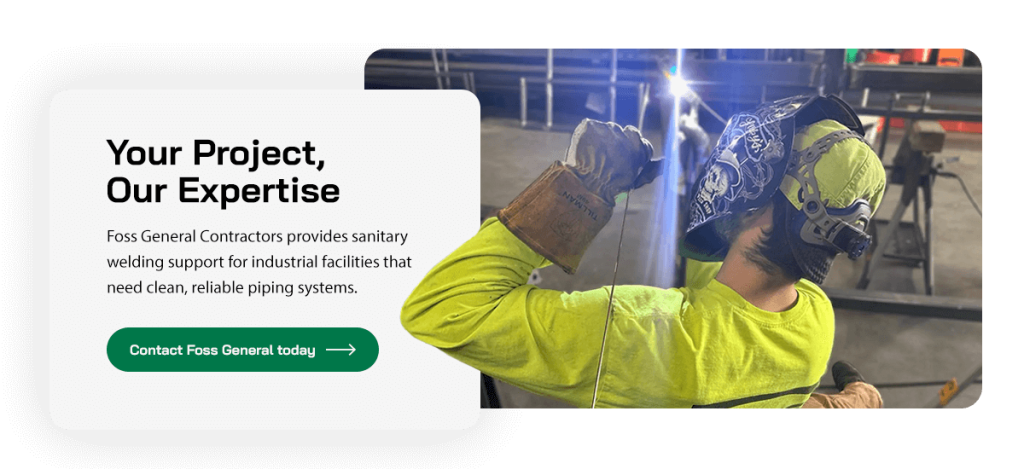
Your Project, Our Expertise
Foss General Contractors provides sanitary welding support for industrial facilities that need clean, reliable piping systems. Contact Foss General today for a consultation on your next sanitary welding project.