When production depends on reliable plumbing and equipment, contractor selection becomes a critical decision. Choosing the wrong contractor can lead to delays, rework or unexpected shutdowns. The right partner needs more than general construction experience. They should understand industrial systems, production environments and the demands of working around active facilities.
Before reviewing bids, there are a few key areas to consider. Foss General Contractors explains how to choose an industrial contractor for plumbing and equipment.
Key Takeaways
A competitive bid does not necessarily indicate a capable industrial contractor. Use these points to compare contractor qualifications before reviewing bids:
- Industrial plumbing expertise: Check the contractor’s experience with the piping systems and materials used in your facility.
- Equipment installation: Confirm their experience in installing, relocating and connecting industrial machinery.
- Industry knowledge: Look for experience in facilities with similar processes and regulatory requirements.
- Certifications: Verify relevant welding, piping and inspection credentials from the American Welding Society (AWS) and the American Society of Mechanical Engineers (ASME).
- Safety performance: Review the contractor’s safety programs, training and performance history.
- Effective communication: Look for a clear reporting structure and transparent communication practices.
Industrial Contractor Qualifications for Plumbing and Equipment
Consider the following criteria before partnering with an industrial contractor.
1. Expertise in Industrial Plumbing Systems and Equipment
Industrial plumbing involves systems that support production and basic facility operations. Depending on the plant, those systems may transport water, steam, compressed air, gases, chemicals, sanitary waste or process materials. This is distinct in scope and code compliance requirements from process piping. Pipe materials and code compliance vary by application.
For many facilities, the scope may include running new pipelines, repairing existing piping, modifying utility connections or supporting facility improvements tied to production equipment. Reviewing these details early can help you compare each contractor’s practical experience against the work your plant actually needs.
Experience with these systems requires more than knowing how to install pipe. A qualified industrial contractor should understand:
- Pipe repair
- Temperature
- Flow requirements
- Material compatibility
- Pipe fitting and line sets
- Applicable codes
They should also know how installation decisions affect the wider production environment. Ask a potential contractor which pipe materials they have worked with. Stainless steel, carbon steel, copper and PVC each have different applications and installation considerations.
Previous project experience matters just as much. Find out whether the contractor has installed or repaired plumbing systems in facilities similar to yours. Ask what the company actually performed rather than accepting a broad list of capabilities. Did the crews fabricate and install piping? Were they responsible for welding, testing or commissioning? Clear answers provide a better picture of the contractor’s practical experience.
Types of Industrial Plumbing and Piping Systems
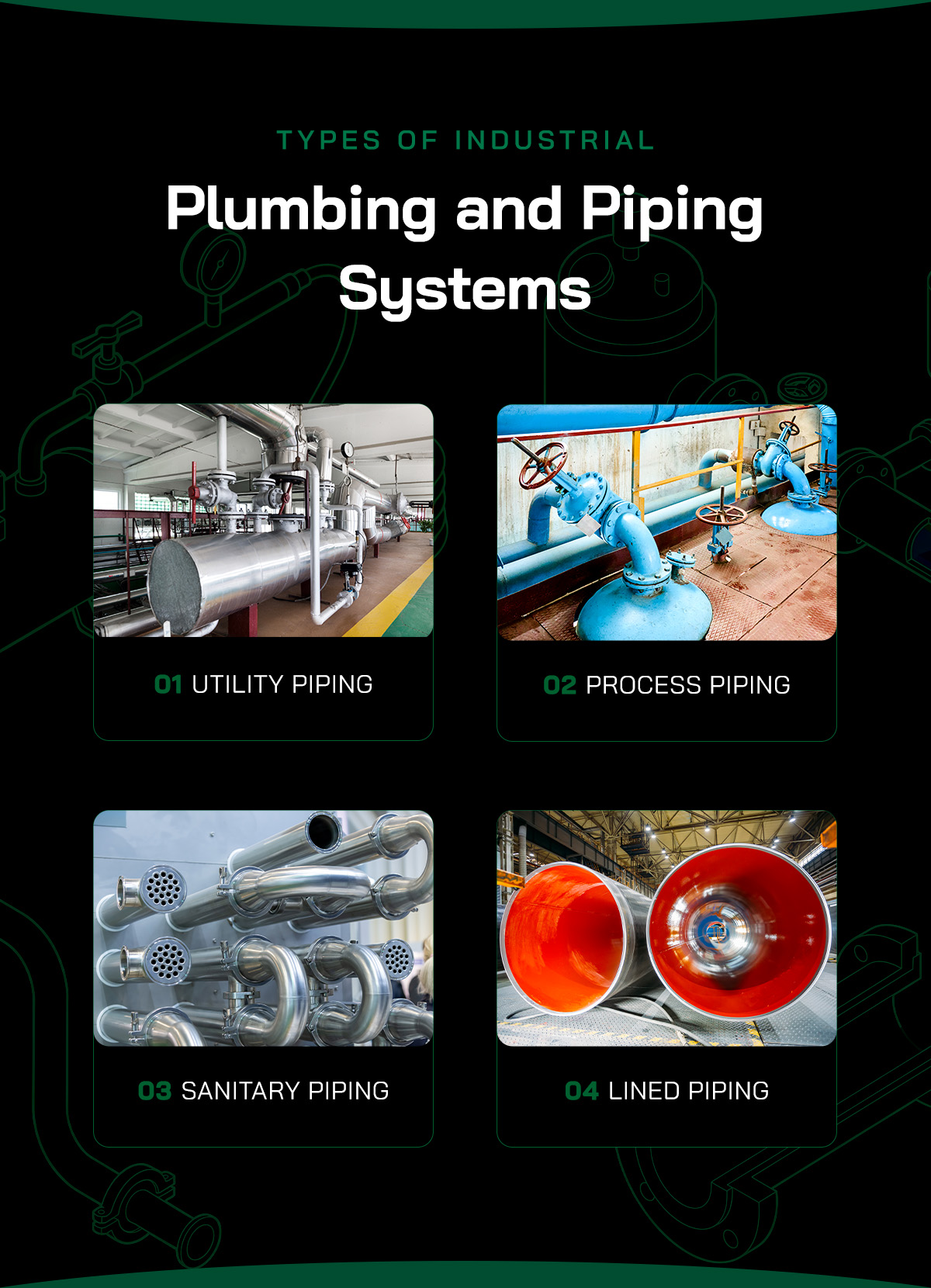
Industrial facilities rely on several types of piping and plumbing systems:
- Utility piping supports essential building and production services. These systems can carry water, steam, natural gas or compressed air.
- Process piping moves raw materials in various states. Depending on the facility, those materials might include chemicals, gases, ingredients or other process fluids. Focus on ASME B31.3 as the governing code for process piping design and installation.
- Sanitary pipingmoves materials used directly in manufacturing. Food processing, beverage and pharmaceutical facilities often have specific requirements for these systems.
- Lined piping can support chemical-processing applications where pipe materials need additional protection from the substances moving through the system. These projects may require careful material selection, code review and installation planning based on the chemicals involved.
This distinction matters during contractor selection. A company with extensive commercial plumbing experience may not have the expertise required for process piping. Ask candidates to identify the systems they have installed, repaired or modified, and request examples from comparable facilities.
What Dual-Scope Capability Means for Your Facility
Plumbing and equipment installation often intersect. For example, a new production machine may require process piping, compressed air, drainage, water or other utility connections. When several contractors handle those tasks, coordination becomes complex. Different supervisors may control different portions of the work, creating additional handoffs and communication points.
Dual-scope capability can also matter when equipment work requires related construction support, such as access platforms, safety structures, equipment supports or facility modifications. When one project team can coordinate these connected needs, it may reduce confusion during planning and field execution.
An integrated contractor can manage related scopes through one project team. Self-performing key trades may also give the contractor greater control over workmanship, scheduling and coordination. Before awarding the project, ask the contractor:
- Which plumbing and piping work do you self-perform?
- What work do you subcontract?
- Who coordinates equipment connections?
- Who manages trade scheduling?
- How are field changes handled?
- Will one project manager oversee the full scope?
- How do crews coordinate work around production?
The key question is whether the contractor can explain where plumbing, piping, equipment placement, structural support and trade coordination overlap.
2. Equipment Installation Experience
Most industrial equipment installation involves considerably more than moving machinery into position. Equipment may require precise placement, alignment, anchoring and connection to facility systems. The surrounding infrastructure should also be accounted for. Installation can involve piping, structural supports, access planning, fabrication and coordination with electrical trades.
Ask whether the contractor has experience planning around the equipment’s footprint, utility needs, access points and supporting structures. Industrial equipment projects often affect more than the machine itself, so the contractor should be able to explain how piping, anchoring, fabrication and structural considerations fit into the overall installation plan.
Ask these questions as you evaluate the contractor:
- What types of industrial equipment have you installed?
- Have you relocated operating machinery?
- How do you protect equipment during installation?
- Can you coordinate the foundation, utilities and structural supports under a single scope?
Get references that address the contractor’s performance after the contract was awarded. Connect with previous clients to learn more about communication, workmanship, scheduling and how the contractor handled unexpected problems.
3. Industry-Specific Experience
Industrial facilities rarely share identical requirements, highlighting the importance of industry-specific experience. A contractor familiar with your industry may already understand the processes, materials and compliance considerations that shape the work.
In food processing environments, plumbing and equipment work can affect sanitation, drainage, cleaning procedures, production areas and plant production capacity. Ask how the contractor plans to work near active operations, protect sanitary conditions and select materials for applications where cleanliness and durability matter.
Material selection and hygienic installation are important considerations for plumbing and equipment projects. The Food and Drug Administration (FDA) and the U.S. Department of Agriculture (USDA) may have requirements that apply, depending on the facility and its operations. For example, USDA-regulated establishments must address plumbing, drainage, water supply, waste disposal and sanitary conditions.
Other industries bring different challenges. Pharmaceutical facilities may require stringent cleanliness controls. Chemical plants can involve specialized materials and process conditions. Aerospace manufacturing may demand detailed quality procedures and specialized equipment.
4. Relevant Certifications
Certifications provide an additional layer of verification, demonstrating that personnel meet defined qualification requirements. Start by identifying which credentials apply to your project. Then, confirm who holds them and whether those individuals will participate in the work.
Ask for documentation such as welder qualifications, safety program summaries and insurance certificates.
Welding and Piping Credentials
The AWS Certified Welder program uses performance testing to assess a welder’s ability to produce welds under specified conditions. Ask the contractor which qualifications their personnel maintain. Find out how the company manages qualification records and welding documentation. This is what should come up:
- Welder qualification, such as ASME certification, shows that an individual has demonstrated specific welding skills through testing.
- Inspection credentials indicate access to personnel trained to evaluate workmanship against applicable requirements.
- Code knowledge can demonstrate familiarity with standards governing the work.
- Quality control processes support consistent procedures and documentation.
Safety Prequalification Credentials
Third-party safety prequalification platforms are a practical screening tool that industrial facilities use. For instance, a contractor registered in the ISNetworld has submitted safety programs, insurance certificates, OSHA 300 logs and EMR history for third-party review and received a dashboard grade.
Such platforms simplify the initial screening process. They can also help companies identify missing documentation before a contractor reaches the jobsite.
5. Safety Compliance
Safety compliance is a legal requirement, but its importance extends beyond regulatory obligations. An incident can interrupt production, damage equipment and affect employees, contractors and schedules. For that reason, evaluate safety through documented evidence. Look at the contractor’s programs, training, performance data and approach to hazard control.
Ask for OSHA logs, EMR history and examples of comparable project scopes.
Experience Modification Rate (EMR)
The EMR is one measure of a contractor’s workers’ compensation claims history. An EMR of 1.0 is average — anything above that number indicates an above-average claims history. Consider this measure alongside incident rates, OSHA records, training practices and the contractor’s written safety program.
Written Safety Plans and OSHA Standards
A written safety plan offers a clearer view of how a contractor identifies and controls workplace hazards. Ensure this contractor plan covers:
- Hazard assessments
- Job-specific planning
- Training
- Personal protective equipment
- Emergency response
- Inspections
- Incident reporting
- Corrective action
6. Project Management and Communication
Strong project management converts technical capability into reliable execution. A structured management approach should cover scheduling, procurement, documentation, progress reporting and changes to the agreed scope. Look for a clear reporting structure and transparent communication practices. This makes problems easier to identify, communicate and resolve before they can grow.
Downtime Minimization
Downtime planning should begin before the proposal is finalized, not after crews arrive on-site. Production interruption can be one of the largest concerns surrounding industrial construction. Even a relatively short outage may affect output, deliveries and customer commitments. A contractor focused on uptime will consider plant operations during the planning stage. The team may divide work into phases, prepare materials away from the production area or schedule critical activities during planned outages.
The goal is not just to finish the work, but to plan it in a way that reduces disruption to production. Ask how the contractor prepares materials, sequences crews and coordinates shutdown windows to help your facility maintain as much production capacity as possible during the project.
Access also matters. Crews need routes for people, tools, equipment and materials without interfering unnecessarily with production.
Schedule Reliability
Speed and reliability are crucial. A fast proposed schedule means little if the contractor lacks the people, materials or equipment needed to support it.
A dependable schedule accounts for procurement, fabrication, inspections, permits, site access and other dependencies. It should identify milestones and activities that could affect the critical path. Resource availability deserves equal attention. A contractor may have an impressive portfolio while carrying a heavy workload when your project is ready to begin.
Before signing, ask about:
- Current project commitments
- Expected start date
- Crew availability
- Key trade availability
- Material lead times
- Major schedule dependencies
- Potential causes for delay
- Procedures for communicating changes
Industrial Contractor Vetting Checklist
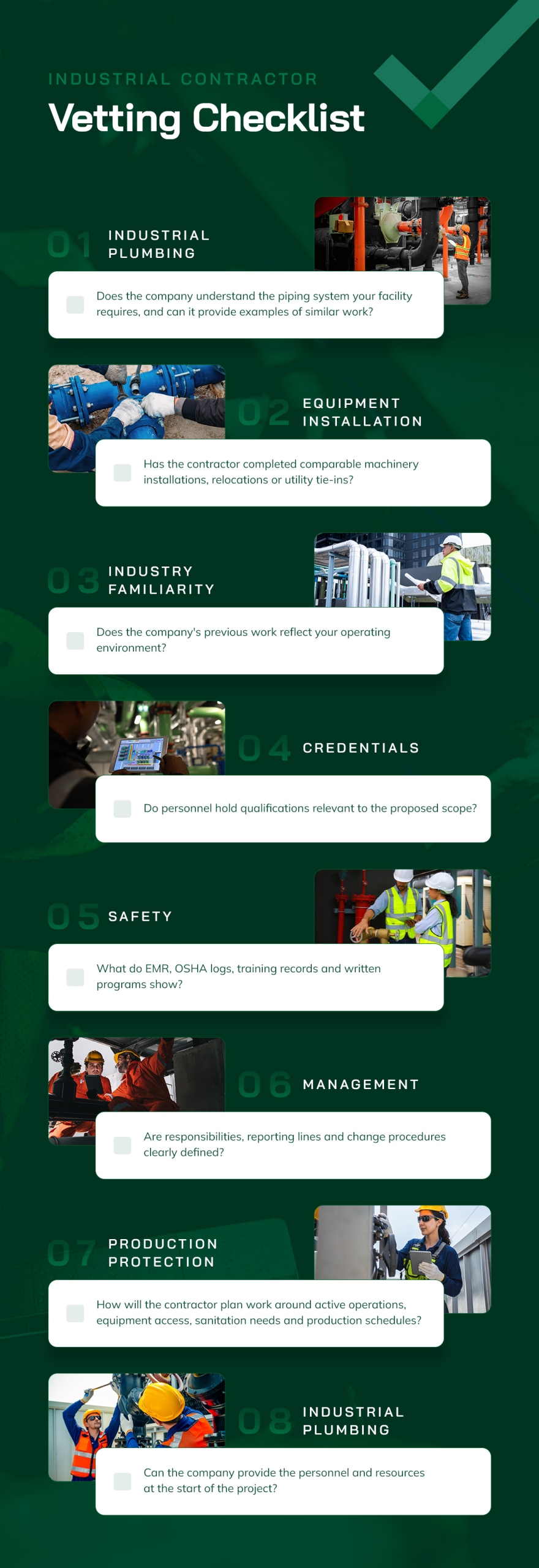
Use this checklist to structure your review of any industrial contractor. Each one addresses a different part of contractor performance:
- Industrial plumbing: Does the company understand the piping system your facility requires, and can it provide examples of similar work?
- Equipment installation: Has the contractor completed comparable machinery installations, relocations or utility tie-ins?
- Industry familiarity: Does the company’s previous work reflect your operating environment?
- Credentials: Do personnel hold qualifications relevant to the proposed scope?
- Safety: What do EMR, OSHA logs, training records and written programs show?
- Management: Are responsibilities, reporting lines and change procedures clearly defined?
- Production protection: How will the contractor plan work around active operations, equipment access, sanitation needs and production schedules?
- Capacity: Can the company provide the personnel and resources at the start of the project?
Vague answers, missing documentation, unclear project leadership or limited examples from similar facilities may indicate a higher risk of delays or rework.
Putting This Checklist to Work
The contractor selection process should start before bids arrive. First, define the technical demands of the project. Identify the piping systems, materials and operating conditions that will shape the work. Use those requirements to screen potential providers. A contractor’s past projects should demonstrate meaningful similarities.
Credentials can then provide another layer of verification. Examine relevant welding and piping qualifications, third-party prequalification information and safety documentation. Consider measurable indicators such as EMR alongside the contractor’s written procedures.
Finally, examine how the company plans to deliver the work. Review project leadership, communication, shutdown planning, scheduling and available resources. These factors determine whether technical capability can translate into dependable execution.
For industrial facilities, the strongest fit is often a contractor that understands both the technical scope and the production environment. Plumbing, piping, equipment installation and related structural work should be planned together so that the project supports the facility’s operations rather than creating unnecessary disruption.